Skip to content
Bookkeeping & Accounting Company in Dubai - UAE Bookkeeping & Accounting Company in Dubai - UAE
  • Home
  • About Us
  • Services
    • Specialized Tax Services
    • Accounting & Bookkeeping
    • UAE Corporate Tax Services
    • VAT Services
    • Tax Advisory & Structuring
    • CFO Services
    • Audit Support & Compliance
  • Locations We Serve
    • Dubai
    • Abu Dhabi
    • Sharjah
  • Industries We Serve
    • E-commerce & Online Retail
    • Construction & Contracting
    • Real Estate & Property Development
  • Staffing
  • Blog
Contact Us
Home/Financial Planning & Growth/How to Organize Financial Records for Better Tax Compliance
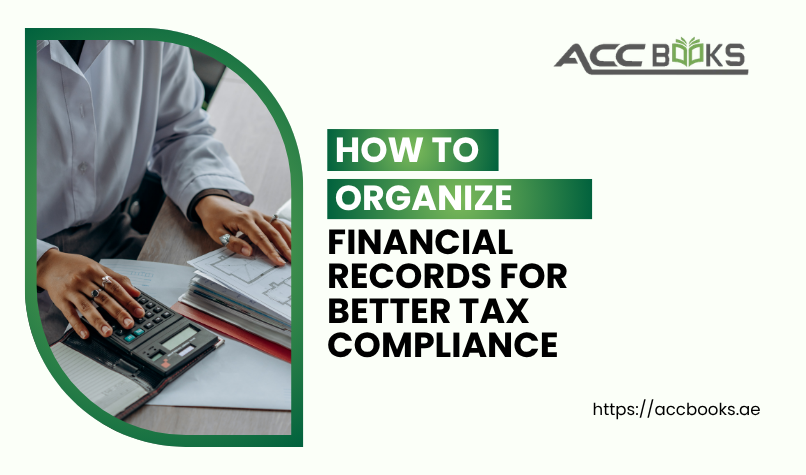
A well-organized workspace showing a professional accountant filing documents into clearly labeled folders and binders, with categories such as "Invoices," "Receipts," "Bank Statements," and "Tax Returns." A laptop on the desk displays a digital document management system with scanned receipts and automated expense categorization. A color-coded filing system and a digital scanner are visible, symbolizing the blend of physical and digital methods used to Organize Financial Records. The scene conveys order, efficiency, and compliance readiness for tax purposes.
Financial Planning & GrowthBusiness FinanceFinancial ManagementTax & ComplianceTax Advisory & StructuringTax Compliance

How to Organize Financial Records for Better Tax Compliance

Hasan Usmani
By Hasan Usmani
November 2, 2026 6 Min Read
0

Learn how to organize financial records for better tax compliance. Accounting & Bookkeeping and UAE Corporate Tax Services from AccBooks.

Table of Contents

  • The Paper Trail That Saves You: How to Organize Financial Records for Better Tax Compliance
    • Why Financial Records Organization Decides Your Compliance Outcome
      • The Link Between Records and Every Tax Filing
      • What Counts as a Financial Record
    • Building a Filing Structure That Survives a Busy Year
      • Sort by Type, Then by Period
      • Apply a Naming Convention
      • Store Originals Securely
      • The Technical Nuance of Digital Records
    • Retention and Retrieval: The Rules That Matter
      • How Long to Keep Records
      • Producing Records on Request
    • A Tale of Two Businesses: The Records Table
      • The Role of Professional Accounting & Bookkeeping
    • Common Questions About Organizing Financial Records
      • Can I Keep Only Digital Copies?
      • What Happens If Records Are Missing?
      • Does Good Organization Reduce Audit Risk?
      • How Does This Connect to Corporate Tax?
    • Final Thought: The Insight That Changes Everything

The Paper Trail That Saves You: How to Organize Financial Records for Better Tax Compliance

TL;DR (Key Insights):

  • Structure Beats Volume: A clear filing system matters more than the size of your archive.
  • Retention Has Rules: Records must be kept for a defined period and produced on request.
  • Digital Copies Count: Electronic records are acceptable if they are legible and secure.
  • One System, Many Uses: Clean records serve VAT, Corporate Tax, and audit needs together.
  • Expert Support Helps: Professional Accounting & Bookkeeping builds the structure for you.

Here is the short answer: to organize financial records for better tax compliance, sort every document into a consistent structure by type and by period, store originals securely, keep legible digital backups, apply a naming convention that identifies the document at a glance, and retain everything for the period the tax authority requires. That is the framework. The difficulty is not in knowing it. It is in keeping it alive across a busy trading year.

Why Financial Records Organization Decides Your Compliance Outcome

Records are the raw material of every tax position you take. The best part? Organizing them well is entirely within your control. Look: a tax authority does not assess your intentions. It assesses your evidence.

The Link Between Records and Every Tax Filing

Each filing you submit is a summary drawn from underlying documents.

  • VAT Returns: Built from invoices, credit notes, and payment records.
  • Corporate Tax Returns: Built from ledgers, statements, and supporting schedules.
  • Audit Reviews: Built from the complete documentary chain behind each figure.
  • Adjustments: Supported by documentation that explains each change.

Definition Box: Financial records organization is the structured arrangement of invoices, receipts, bank statements, ledgers, contracts, and tax filings into a consistent system that allows a business to retrieve any supporting document quickly, produce it on request, and defend every figure reported in its tax returns.

What Counts as a Financial Record

The definition is wider than most owners assume. This catches people out.

  • Sales Documents: Invoices, credit notes, and delivery notes.
  • Purchase Documents: Supplier invoices, receipts, and contracts.
  • Banking Records: Statements, deposit slips, and payment confirmations.
  • Payroll Records: Salary schedules, contracts, and end of service files.
  • Tax Filings: Submitted returns and their acknowledgments.
  • Internal Records: Ledgers, journals, and reconciliation sheets.

Building a Filing Structure That Survives a Busy Year

Here is where most systems fail. They are designed in a quiet week and abandoned in a busy one. Here is why: complexity is the enemy of consistency.

Sort by Type, Then by Period

The simplest structure is the one people actually follow.

  • Type First: Group documents by category, such as sales, purchases, payroll, and banking.
  • Period Second: Within each category, file by month and year.
  • Sequential Order: Keep invoices in number order within each period.
  • One Place: Every document has exactly one correct home.

Apply a Naming Convention

Digital files need names that identify them without opening them.

  • Consistent Pattern: Date, type, counterparty, and reference number.
  • No Vague Labels: Avoid names that describe nothing.
  • No Duplicates: Never keep a copy in a second folder.
  • Version Control: Mark revised documents clearly rather than overwriting them.

Store Originals Securely

Originals carry weight that copies do not.

  • Locked Storage: Physical originals belong in controlled storage.
  • Access Limits: Only named people may retrieve them.
  • Retrieval Log: Record who took what and when.
  • Return Discipline: Every document comes back to its place.

The Technical Nuance of Digital Records

Electronic records are acceptable, but only if they remain legible, complete, and retrievable for the full retention period. This creates an obligation most businesses overlook: your storage format must survive software changes. A scanned document locked in a discontinued system is not a record you can produce. Keep copies in a common, open format alongside your primary system.

Retention and Retrieval: The Rules That Matter

Retention is where organization meets obligation. Records must be kept for the period the tax authority specifies and produced when requested.

How Long to Keep Records

The retention period is set by regulation and applies to both paper and digital copies.

  • Standard Period: A defined number of years from the end of the relevant tax period.
  • Extended Cases: Certain records, such as those tied to assets, may be kept longer.
  • Pending Matters: Keep records longer where a review or dispute is unresolved.
  • Expert Confirmation: Your Tax Advisory & Structuring advisor can confirm what applies to you.

Producing Records on Request

Organization proves itself the moment someone asks.

  • Speed of Retrieval: A request should be answered from a single location.
  • Complete Sets: Provide the full documentary chain, not partial selections.
  • Explanatory Notes: Attach a short index explaining each item.
  • No Gaps: Missing documents invite questions you may not want.

A Tale of Two Businesses: The Records Table

The contrast between structured and scattered records is stark.

AspectBusiness A (Unstructured)Business B (Structured)
Filing MethodDocuments in drawers and inboxes.Categorized by type and period.
NamingVague file names and duplicates.Consistent pattern with references.
Retrieval TimeHours of searching, sometimes futile.Located in moments.
Filing AccuracyFigures reconstructed from memory.Figures drawn from source documents.
Request ResponseDelayed and incomplete.Immediate and complete.
StandingReactive and exposed.Confident and audit ready.

The Role of Professional Accounting & Bookkeeping

The difference between these two businesses is professional Accounting & Bookkeeping. When records are captured at the point of transaction, the structure maintains itself.

  • Capture at Source: Every transaction recorded as it happens.
  • Categorized Filing: Documents attached to their ledger entries.
  • Reconciliation Routine: Regular checks keep the archive honest.
  • Continuity: The system survives staff changes.

Common Questions About Organizing Financial Records

Can I Keep Only Digital Copies?

Digital copies are acceptable when they are legible, complete, and retrievable for the full retention period. Confirm your specific obligations with an advisor before discarding originals.

What Happens If Records Are Missing?

Missing records weaken every figure you reported. Expect adjustments in the authority’s favour and, in serious cases, penalties.

Does Good Organization Reduce Audit Risk?

It does not remove the possibility of review, but it shortens reviews, reduces findings, and strengthens your position when questions arise.

How Does This Connect to Corporate Tax?

Your UAE Corporate Tax Services depend on the same records. Clean books support accurate profit calculation, correct deductions, and defensible returns.

Final Thought: The Insight That Changes Everything

Let us close the loop we opened early. We promised an insight most guides miss, and here it is: record organization is not a filing task. It is a retrieval promise. The value of your archive is not measured when you file. It is measured on the day someone asks for a document you cannot find.

That day arrives without warning. It may come as a routine review, a supplier dispute, a bank request, or a question about a single figure filed long ago. Businesses that built structure early answer in moments. Businesses that did not spend weeks reconstructing a past they can no longer prove.

Start with a simple structure. Keep it consistent. Retain everything. And let experts hold the standard while you trade.

Are you ready to turn your records into a system you can trust?

Contact AccBooks today for a comprehensive consultation. Let our expert team manage your Accounting & Bookkeeping, deliver precise Tax Advisory & Structuring, and handle your UAE Corporate Tax Services so every document you hold stands ready when it matters. Your compliance is our priority.
Tags:

AccBooks DubaiAccounting & Bookkeepingbookkeeping UAETax Advisory & StructuringUAE Corporate Tax Services
Hasan Usmani
Author

Hasan Usmani

Follow Me
Other Articles
A close-up view of a professionally prepared UAE tax invoice displayed on a clipboard, featuring all mandatory fields including the supplier's TRN, invoice number, VAT amount, and the date of supply. A magnifying glass hovers over the document, highlighting the FTA-compliant details, while a checklist beside it marks off key VAT Invoicing Requirements such as "TRN Displayed," "Tax Rate Specified," and "Invoice Numbered Sequentially." A laptop in the background displays the FTA EmaraTax portal, and a UAE flag sits in the corner, reinforcing the regulatory context of VAT-compliant invoicing for UAE businesses.
Previous

VAT Invoicing Requirements Every UAE Business Should Understand

Comparison chart showing taxable income versus accounting profit under UAE Corporate Tax, including adjustments for exempt income, disallowed expenses, and tax losses
Next

Taxable Income vs. Accounting Profit Under UAE Corporate Tax

No Comment! Be the first one.

    Leave a Reply Cancel reply

    Your email address will not be published. Required fields are marked *

    Send Us Message


    Recent Posts

    • Taxable Income vs. Accounting Profit Under UAE Corporate Tax
    • How to Organize Financial Records for Better Tax Compliance
    • VAT Invoicing Requirements Every UAE Business Should Understand
    • Audit Preparation Checklist for Companies in the UAE
    • How Accurate Bookkeeping Helps Prepare Your Business for an Audit

    Categories

    • Accounting & Bookkeeping
    • Accounting Mistakes to Avoid
    • Accounting Tips & Guides
    • Accounting Tips for SMEs UAE
    • Audit & Assurance
    • Audit Support & Compliance
    • Bookkeeping Solutions
    • Business Advisory
    • Business Advisory & Strategy
    • Business Compliance
    • Business Efficiency
    • Business Finance
    • Business Financial Relief
    • Business Operations
    • Business Resources
    • Business Setup & Compliance
    • Business Setup & Structuring
    • Business Strategy
    • Business Travel
    • Case Studies & Compliance Strategies
    • Case Studies & Success Stories
    • CFO Insights
    • CFO services
    • Cloud Accounting & Technology
    • Compliance & Audit Support
    • Compliance Guides
    • Construction Industry
    • Dispute Resolution
    • E-Commerce
    • Entrepreneurship & Startups
    • Financial Management
    • Financial Planning
    • Financial Planning & Growth
    • Founder's Guide
    • Free Zone Business
    • FTA Penalties & Defense
    • FTA Procedures
    • FTA reconsideration request
    • FTA Regulations
    • FTA voluntary disclosure UAE
    • Global Business
    • Industry Insights & Trends
    • Industry News & Updates
    • Industry-Specific Guides
    • International Business
    • International Taxation
    • Legal & Regulatory
    • Legal Advisory
    • Manufacturing accounting
    • Penalties & Waivers
    • Penalty Management
    • Penalty Relief
    • Property Management
    • Real Estate Industry
    • Registration & Filing
    • Retail Industry
    • Risk Management
    • Small Business Advice
    • SME Advisory
    • Specialized Bookkeeping Services
    • Specialized Tax Services
    • Tax & Compliance
    • Tax Advisory & Structuring
    • Tax Compliance
    • Tax Dispute Resolution
    • Tax Disputes & Resolution
    • Tax Penalty Management
    • Tax Refunds & Recovery
    • Technology & Software
    • Transfer Pricing
    • UAE Business Law
    • UAE Corporate Tax
    • UAE Corporate Tax Guide
    • UAE Startups
    • UAE Tax & Accounting
    • UAE Tax & Compliance
    • VAT in Dubai
    • VAT in UAE
    • VAT Services
    Facebook Twitter Youtube

    Quick Links

    • Home
    • About
    • Services
    • Pricing
    • Industries We Serve
    • Areas We Serve in UAE

    Services

    • Accounting & Bookkeeping
    • UAE Corporate Tax Services
    • VAT Services
    • Tax Advisory & Structuring
    • CFO Services
    • Audit Support & Compliance

    Resources

    • Help Center
    • Contact Support
    • Case Studies
    • FAQs
    • Blog / Insights
    • Privacy Policy

    Connect With Us

    • +971 56 994 1162
    • info@accbooks.ae
    • Office No. 410, Port Saeed, Deira, Dubai

    2026 Copyright ©ACCBOOKS

    Sitemap
    Disclaimer

    Call

    Email

    WhatsApp