Skip to content
Bookkeeping & Accounting Company in Dubai - UAE Bookkeeping & Accounting Company in Dubai - UAE
  • Home
  • About Us
  • Services
    • Specialized Tax Services
    • Accounting & Bookkeeping
    • UAE Corporate Tax Services
    • VAT Services
    • Tax Advisory & Structuring
    • CFO Services
    • Audit Support & Compliance
  • Locations We Serve
    • Dubai
    • Abu Dhabi
    • Sharjah
  • Industries We Serve
    • E-commerce & Online Retail
    • Construction & Contracting
    • Real Estate & Property Development
  • Blog
  • Home
  • About Us
  • Services
    • Specialized Tax Services
    • Accounting & Bookkeeping
    • UAE Corporate Tax Services
    • VAT Services
    • Tax Advisory & Structuring
    • CFO Services
    • Audit Support & Compliance
  • Locations We Serve
    • Dubai
    • Abu Dhabi
    • Sharjah
  • Industries We Serve
    • E-commerce & Online Retail
    • Construction & Contracting
    • Real Estate & Property Development
  • Blog
Close

Search

  • https://www.facebook.com/
  • https://twitter.com/
  • https://t.me/
  • https://www.instagram.com/
  • https://youtube.com/
Contact Us
Bookkeeping & Accounting Company in Dubai - UAE Bookkeeping & Accounting Company in Dubai - UAE
  • Home
  • About Us
  • Services
    • Specialized Tax Services
    • Accounting & Bookkeeping
    • UAE Corporate Tax Services
    • VAT Services
    • Tax Advisory & Structuring
    • CFO Services
    • Audit Support & Compliance
  • Locations We Serve
    • Dubai
    • Abu Dhabi
    • Sharjah
  • Industries We Serve
    • E-commerce & Online Retail
    • Construction & Contracting
    • Real Estate & Property Development
  • Blog
  • Home
  • About Us
  • Services
    • Specialized Tax Services
    • Accounting & Bookkeeping
    • UAE Corporate Tax Services
    • VAT Services
    • Tax Advisory & Structuring
    • CFO Services
    • Audit Support & Compliance
  • Locations We Serve
    • Dubai
    • Abu Dhabi
    • Sharjah
  • Industries We Serve
    • E-commerce & Online Retail
    • Construction & Contracting
    • Real Estate & Property Development
  • Blog
Close

Search

  • https://www.facebook.com/
  • https://twitter.com/
  • https://t.me/
  • https://www.instagram.com/
  • https://youtube.com/
Contact Us
Home/Accounting & Bookkeeping/Zero-Rated vs Exempt: Maximizing Tax Claims
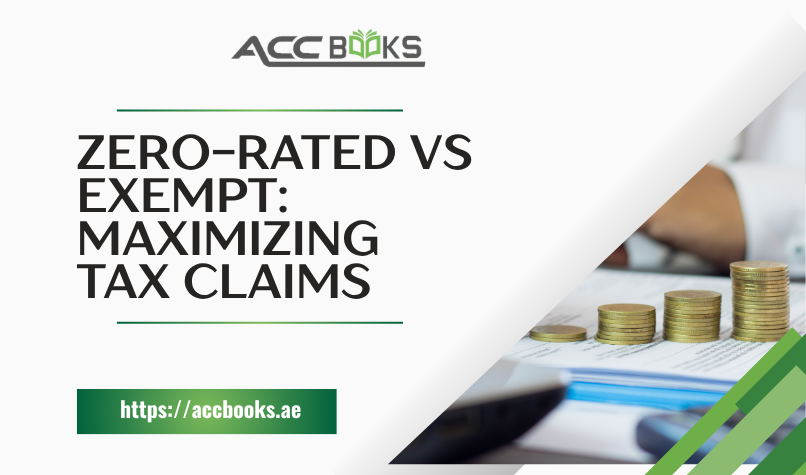
Zero-Rated vs Exempt comparison chart showing VAT treatment, input tax recovery, and tax claim differences for UAE businesses
Accounting & BookkeepingTax Advisory & StructuringUAE Tax & ComplianceVAT Services

Zero-Rated vs Exempt: Maximizing Tax Claims

Hasan Usmani
By Hasan Usmani
September 15, 2026 5 Min Read
0

Understand zero-rated vs exempt supplies in UAE VAT. Learn how each impacts your input tax recovery and maximize your tax claims legally.

Table of Contents

  • Zero-Rated vs Exempt: Maximizing Tax Claims Without Losing Money
    • What Is the Difference Between Zero-Rated and Exempt?
    • Understanding Zero-Rated Supplies
      • Common Examples
      • The Benefit: Input Tax Recovery
    • Understanding Exempt Supplies
      • Common Examples
      • The Drawback: No Input Tax Recovery
    • The Critical Difference: Input Tax Recovery
      • Zero-Rated vs Exempt: A Comparison
    • The Apportionment Challenge
      • What Is Apportionment?
      • Methods of Apportionment
    • Maximizing Your Tax Claims
      • Structure for Zero-Rating
      • Separate Exempt Activities
      • Review Your Costs
      • Claim on Time
    • The Critical Insight Revealed
    • The Role of Professional Services
    • Frequently Asked Questions
    • Final Thought
      • Are you confident in your classification of zero-rated and exempt supplies?

Zero-Rated vs Exempt: Maximizing Tax Claims Without Losing Money

Are you unknowingly leaving thousands of dirhams on the table? Here is a critical distinction that trips up even seasoned business owners: zero-rated and exempt supplies are not the same thing. This single misunderstanding can cost you significant input tax recovery. The good news? Once you understand the difference, you can optimize your tax position and maximize your legitimate claims. This guide breaks down everything you need to know.

Key Insights (TL;DR):

  • Zero-Rated Means Taxable: You charge VAT at zero percent and can recover input tax.
  • Exempt Means Not Taxable: You charge no VAT but cannot recover input tax on related costs.
  • Input Tax Recovery: Zero-rated supplies allow full recovery; exempt supplies do not.
  • Apportionment Rules: Mixed businesses must apportion input tax correctly.
  • Strategic Planning: Understanding this distinction helps structure your business for maximum recovery.

What Is the Difference Between Zero-Rated and Exempt?

This is the foundational question. Get this wrong, and your entire VAT position is compromised.

Zero-rated supplies are taxable supplies subject to VAT at a rate of zero percent, allowing full input tax recovery. Exempt supplies are not subject to VAT, and input tax related to them cannot be recovered.

Look: the key difference is input tax recovery. Zero-rated is your friend. Exempt is not.

Understanding Zero-Rated Supplies

Zero-rated supplies are taxable. They just happen to have a tax rate of zero percent.

Common Examples

  • Exports of goods and services outside the GCC.
  • International transportation services.
  • First sale of residential property within a specific period.
  • Certain educational services.
  • Healthcare services meeting specific conditions.

The Benefit: Input Tax Recovery

Because these are taxable supplies, you can recover input tax on costs related to them.

If you make zero-rated supplies, you can claim input tax. This is a significant advantage. Ensure your invoices clearly state the zero-rating and the reason for it.

Understanding Exempt Supplies

Exempt supplies are not taxable. They fall outside the scope of VAT.

Common Examples

  • Certain financial services.
  • Sale of residential property after the first supply.
  • Bare land.
  • Local passenger transport.

The Drawback: No Input Tax Recovery

You cannot recover input tax on costs related to exempt supplies.

If you make exempt supplies, the VAT you pay on related expenses becomes a real cost. You cannot claim it back. This increases your overall expenses.

The Critical Difference: Input Tax Recovery

This is where the money is.

Zero-Rated vs Exempt: A Comparison

AspectZero-Rated SuppliesExempt Supplies
VAT RateZero percent.No VAT.
Input Tax RecoveryFully recoverable.Not recoverable.
NatureTaxable supplies.Non-taxable supplies.
ExamplesExports, international transport.Financial services, bare land.
Impact on BusinessPositive. You recover VAT.Negative. VAT becomes a cost.

The Apportionment Challenge

Many businesses make both taxable and exempt supplies. This creates complexity.

What Is Apportionment?

You must divide your input tax between taxable and exempt activities. Only the taxable portion is recoverable.

Methods of Apportionment

The FTA allows specific methods. These include:

  • Turnover-based method.
  • Transaction count method.
  • Special methods approved by the FTA.

Choose your apportionment method carefully. The wrong method can significantly reduce your recovery. Document your methodology clearly.

Maximizing Your Tax Claims

Here is how to legally maximize your input tax recovery.

Structure for Zero-Rating

If possible, structure your business to make zero-rated supplies. This allows full input tax recovery.

Separate Exempt Activities

If you have exempt activities, consider separating them into a distinct legal entity. This prevents the exempt activities from contaminating your recoverable input tax.

Review Your Costs

Identify costs directly attributable to taxable supplies. These are fully recoverable. Costs attributable to exempt supplies are not.

Claim on Time

Ensure you claim input tax within the allowed timeframe. The FTA has strict rules on this.

Keep detailed records of all supplies. Document the nature of each supply. This makes apportionment easier and reduces audit risk.

The Critical Insight Revealed

Remember the insight we promised? Here it is: many businesses overpay VAT because they incorrectly classify supplies as exempt when they are actually zero-rated.

This misclassification is often due to a lack of understanding. For example, exports are zero-rated, not exempt. If you treat them as exempt, you lose the ability to recover input tax. This is a costly error.

Review your supply classification regularly. Ensure you are applying the correct treatment. The difference can be substantial.

The Role of Professional Services

Navigating the zero-rated versus exempt distinction requires expertise.

Specialized Tax Services provide deep knowledge of VAT law. They ensure correct classification of your supplies.

VAT Services experts help you optimize your input tax recovery. They review your transactions and advise on the best approach.

Accounting & Bookkeeping ensures your records are accurate and organized. This is essential for proper apportionment.

Tax Advisory & Structuring can help restructure your business to maximize tax efficiency.

Audit Support & Compliance prepares you for FTA inquiries. They ensure your claims are defensible.

UAE Corporate Tax Services ensure your Corporate Tax position is also optimized.

CFO Services provide strategic oversight. They align your tax strategy with your business goals.

Frequently Asked Questions

What is the main difference between zero-rated and exempt?

Zero-rated supplies are taxable at zero percent and allow input tax recovery. Exempt supplies are not taxable and do not allow input tax recovery.

Can I claim input tax on zero-rated supplies?

Yes. Zero-rated supplies allow full input tax recovery.

Can I claim input tax on exempt supplies?

No. Input tax related to exempt supplies cannot be recovered.

How do I apportion input tax if I make both types of supplies?

You must use an FTA-approved method, such as turnover-based or transaction count.

What happens if I misclassify a supply?

Misclassification can lead to incorrect VAT returns. This may trigger penalties and interest.

Can I change my apportionment method?

Yes, but you must notify the FTA and have valid reasons for the change.

Final Thought

The distinction between zero-rated and exempt supplies is not just a technicality. It is a fundamental driver of your tax position. Get it right, and you recover more. Get it wrong, and you lose money.

Understanding this difference empowers you to make smarter business decisions. It helps you structure your operations for maximum efficiency. It protects you from costly errors.

Do not treat VAT as an afterthought. Treat it as a strategic tool. The money you recover is money you can reinvest in growth.

Are you confident in your classification of zero-rated and exempt supplies?

Do not leave your tax recovery to chance.AccBooks is a leading provider of comprehensive VAT and tax services in the UAE. Our experts can review your transactions, ensure correct classification, and maximize your legitimate tax claims.

Contact AccBooks today for a free VAT health check. Let us help you recover every dirham you are owed and build a tax-efficient future.

Tags:

Accounting & BookkeepingAudit Support & ComplianceTax Advisory & StructuringVAT services
Hasan Usmani
Author

Hasan Usmani

Follow Me
Other Articles
A clear infographic-style illustration showing a foreign supplier on the left side, depicted with a globe and international invoice icon, and a UAE-based business on the right side, represented by a modern office building with a UAE flag. A prominent curved arrow labeled "Reverse Charge Rule" loops back from the UAE business to the FTA, symbolizing the shift of VAT liability from the foreign supplier to the local buyer. A digital invoice on the screen highlights key fields including "VAT Amount Self-Assessed," "EmaraTax Entry," and "Input Tax Credit Claim." A magnifying glass zooms in on the transaction pathway, emphasizing compliance scrutiny. The background features a subtle map of international trade routes, reinforcing the cross-border nature of foreign invoices under the Reverse Charge Rule.
Previous

The Reverse Charge Rule for Foreign Invoices

A well-organized professional workspace featuring a laptop displaying a digital accounting dashboard with VAT transaction records, alongside neatly arranged physical folders labeled "Sales Invoices," "Purchase Receipts," and "VAT Returns." A financial auditor is reviewing a checklist titled "VAT Audit Readiness," with checkboxes for "Accurate Records," "Proper Invoicing," and "Reconciliation." A calculator, a stamp marked "AUDITED," and a calendar highlighting key VAT filing dates sit on the desk. In the background, a bookshelf filled with organized binders symbolizes structured Bookkeeping for VAT, reinforcing the importance of meticulous record-keeping ahead of an FTA audit.
Next

How to Prepare Your Bookkeeping for VAT Audits

No Comment! Be the first one.

    Leave a Reply Cancel reply

    Your email address will not be published. Required fields are marked *

    Send Us Message


    Recent Posts

    • Step-by-Step VAT Remediation Checklist
    • Best Practices for Automated VAT Invoicing
    • Why Bad Bookkeeping Triggers VAT Fines
    • Contractor VAT Compliance for Mega Projects
    • Claiming VAT Refunds for Overseas Visitors

    Categories

    • Accounting & Bookkeeping
    • Accounting Mistakes to Avoid
    • Accounting Tips & Guides
    • Accounting Tips for SMEs UAE
    • Audit & Assurance
    • Audit Support & Compliance
    • Bookkeeping Solutions
    • Business Advisory
    • Business Advisory & Strategy
    • Business Compliance
    • Business Efficiency
    • Business Finance
    • Business Financial Relief
    • Business Operations
    • Business Resources
    • Business Setup & Compliance
    • Business Setup & Structuring
    • Business Strategy
    • Business Travel
    • Case Studies & Compliance Strategies
    • Case Studies & Success Stories
    • CFO Insights
    • CFO services
    • Cloud Accounting & Technology
    • Compliance & Audit Support
    • Compliance Guides
    • Construction Industry
    • Dispute Resolution
    • E-Commerce
    • Entrepreneurship & Startups
    • Financial Management
    • Financial Planning
    • Financial Planning & Growth
    • Founder's Guide
    • Free Zone Business
    • FTA Penalties & Defense
    • FTA Procedures
    • FTA reconsideration request
    • FTA Regulations
    • FTA voluntary disclosure UAE
    • Global Business
    • Industry Insights & Trends
    • Industry News & Updates
    • Industry-Specific Guides
    • International Business
    • International Taxation
    • Legal & Regulatory
    • Legal Advisory
    • Manufacturing accounting
    • Penalties & Waivers
    • Penalty Management
    • Penalty Relief
    • Property Management
    • Real Estate Industry
    • Registration & Filing
    • Retail Industry
    • Risk Management
    • Small Business Advice
    • SME Advisory
    • Specialized Bookkeeping Services
    • Specialized Tax Services
    • Tax & Compliance
    • Tax Advisory & Structuring
    • Tax Compliance
    • Tax Dispute Resolution
    • Tax Disputes & Resolution
    • Tax Penalty Management
    • Technology & Software
    • Transfer Pricing
    • UAE Business Law
    • UAE Corporate Tax
    • UAE Corporate Tax Guide
    • UAE Startups
    • UAE Tax & Accounting
    • UAE Tax & Compliance
    • VAT in Dubai
    • VAT in UAE
    • VAT Services
    Facebook Twitter Youtube

    Quick Links

    • Home
    • About
    • Services
    • Pricing
    • Industries We Serve
    • Areas We Serve in UAE

    Services

    • Accounting & Bookkeeping
    • UAE Corporate Tax Services
    • VAT Services
    • Tax Advisory & Structuring
    • CFO Services
    • Audit Support & Compliance

    Resources

    • Help Center
    • Contact Support
    • Case Studies
    • FAQs
    • Blog / Insights
    • Privacy Policy

    Connect With Us

    • +971 56 994 1162
    • info@accbooks.ae
    • Office No. 410, Port Saeed, Deira, Dubai

    2026 Copyright ©ACCBOOKS

    Sitemap
    Disclaimer

    Call

    Email

    WhatsApp