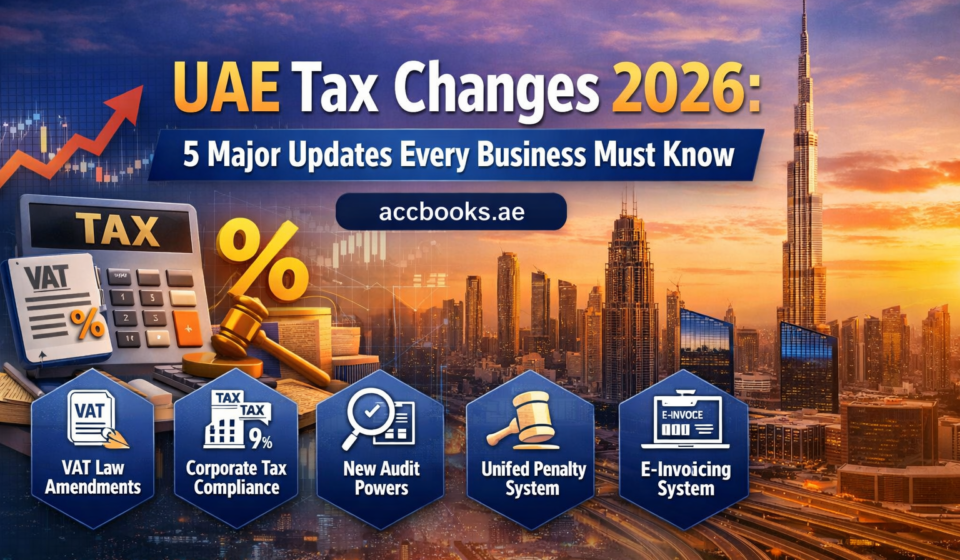
UAE Tax Changes 2026: 5 Major Updates Every Business Must Know

Table of Contents
UAE Tax Changes 2026: 5 Major Updates Every Business Must Know
Running a business in the UAE has always come with its rewards — but 2026 is shaping up to be a year of significant tax reforms. Whether you’re a small startup in Dubai, a trading company in Sharjah, or a growing firm in Abu Dhabi, these changes will directly impact your cash flow, compliance workload, and financial planning.
At AccBooks, we help hundreds of businesses across the UAE navigate these shifts every month. Here’s a clear, straightforward breakdown of the 5 major UAE tax changes in 2026 you cannot afford to ignore.
1. Strict 5-Year Limit on VAT Refund Claims (Effective 1 January 2026)
One of the biggest changes is the introduction of a hard 5-year statute of limitations on excess input VAT recovery.
- From 1 January 2026, you have a maximum of 5 years from the end of the tax period in which the excess VAT arose to either use it against future liabilities or submit a formal refund request.
- Once the 5-year window closes, the right to that credit permanently lapses.
Transitional relief: Businesses with older credits (especially from 2018–2020) have a final grace period until 31 December 2026 to claim them.
Human Tip: Many business owners we speak to still carry forward old VAT credits thinking “I’ll claim it later.” Don’t wait. Review your records now — those unused credits could turn into real cash before they disappear forever.
2. Simplified Reverse Charge Mechanism – No More Self-Invoicing
From 1 January 2026, the requirement to issue a self-invoice under the reverse charge mechanism (RCM) for imported services or goods has been removed.
This change reduces paperwork and makes compliance easier for businesses that frequently import services. However, you must still correctly account for VAT on imports in your returns.
3. E-Invoicing Rollout Begins – Get Ready for Digital Invoicing
The UAE is moving full speed toward mandatory electronic invoicing (e-invoicing):
- July 2026: Pilot phase and voluntary adoption starts.
- January 2027: Mandatory for large businesses (annual revenue ≥ AED 50 million).
- July 2027: Mandatory for all other VAT-registered businesses.
Invoices will need to be issued in structured XML/JSON format through Accredited Service Providers (ASPs). A 24-month grace period for intra-VAT group transactions starts from January 2027.
Pro Tip: Early adoption during the 2026 pilot can give you a competitive advantage and help you test integrations with your accounting software without last-minute pressure.
4. Corporate Tax Small Business Relief – Final Year in 2026
The popular Small Business Relief (SBR), which allows eligible businesses with revenue of AED 3 million or less to be treated as having zero taxable income, is available only for tax periods ending on or before 31 December 2026.
After this date, most businesses will fall under the standard 9% Corporate Tax regime. If you qualify, make sure to elect the relief correctly in your tax return — but also weigh whether preserving tax losses for future years might be more beneficial.
5. Stronger Anti-Evasion Rules and Record-Keeping Requirements
The Federal Tax Authority (FTA) is tightening rules around input tax recovery. Refunds may be denied if the FTA believes the transaction is linked to tax evasion and the buyer “knew or should have known” about suspicious supplier behavior.
Additionally, businesses must maintain clear, accessible digital records — with longer retention periods for certain sectors like real estate.
What Should Businesses Do Now?
These 2026 UAE tax changes are not just about compliance — they’re about protecting your cash flow and avoiding costly penalties.
Here’s a quick action plan:
- Review all outstanding VAT credits and plan claims before the December 2026 deadline.
- Assess your readiness for e-invoicing and start exploring accredited service providers.
- Evaluate whether Small Business Relief is still the best option for your 2026 tax periods.
- Upgrade your bookkeeping processes to cloud-based systems for real-time visibility and easier compliance.
At AccBooks, we specialize in helping businesses in Dubai, Sharjah, and Abu Dhabi stay ahead of these changes. From accurate monthly bookkeeping and VAT reconciliation to full Corporate Tax filing and CFO support, our team ensures you’re compliant without the stress.
Ready to future-proof your finances? Contact AccBooks today for a free compliance health check. Let’s turn these tax updates into opportunities for smarter financial management in 2026 and beyond.